|
Psy2 /
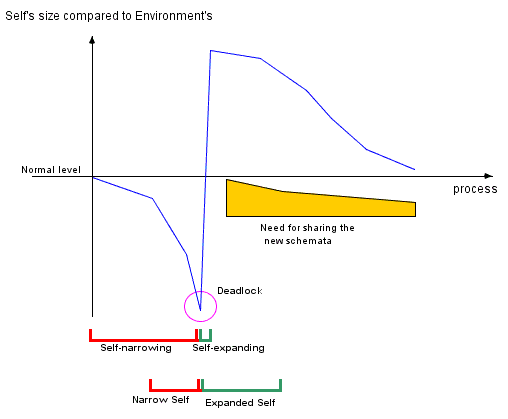
The Paradigmszóval: mik ezek az átalakítások - Az első nagyobb volumenű dolog a FIPP-el kapcsolatban, hogy a cikkben nem egészen a paradigmáról írsz, bár tudom, hogy mire gondolsz, mikor paradigmáról beszélsz, mivel beszéltünk róla. Azért mondom ezt, mert paradigma egy általános dolog, ami megmondja, hogy milyen kérdésekkel foglalkozik a pszichológia, mit tart fontosnak és hogyan értelmezi a vizsgálatok eredményeit. A FIPP article azért nem paradigma, mert túl konkrét helyenként és olyan részletek boncolgatásába megy bele, ami nem a paradigma része, hanem egy gyakorlati kérdés lehet a paradigmán belül. Valamint a másik ok, hogy a paradigma elveit a cikk csak részben és impliciten tartalmazza. Szóval az első változtatás, amit csináltam az volt, hogy egy olyan cikket csináltam, amik csak a paradigmáról szólnak és expliciten vannak benne az alapelvek. Belevettem mindent amiről beszéltünk és ami szerintem még kell hozzá. Ezt láthatod itt nyers formában. Simán el tudom képzelni, hogy most sem teljes még a lista, kiegészítésre vár. Mindenesetre most nem írom tovább addig amig meg nem beszéltük. A kényesebb téma az originalitás. Eddig nem foglalkoztam a FIPP-el, csak amikor elkezdtük a munkát, de régóta szeretném felvázolni, hogy melyek azok a gondolatok, amelyek már felmerültek a pszichológiában. Ahogy most látom, úgy tűnik, hogy az összes gondolat már megvolt korábban, a self-környezet viszony szubjektivitásától az én-határok ilyetén változásáig. Nem csak kezdeményekben, hanem egészen konkrétan így leírták őket. Ez viszont szerintem semmit sem von le a paradigma értékéből, mert ami új a paradigmában, az az, hogy pont ezekből az elvekből áll össze. Számos elképzelés és elmélet közül válogathatnánk a pszichológiában, de pont ezek lesznek az első pszichológiai paradigma alapelvei. Ahogy én látom ez kevés embernek áll így össze a fejében - mind túlságosan korlátozzák a gondolkodásukat egy megközelítésre és nem ismerik fel az összefüggéseket meg a fontos pontokat. Valahogy az az érzésem, hogy még mindig vannak olyan részei ennek a paradigmának, ami csak impliciten van benne a gondolkodásunkban, de másoknak egyáltalán nem evidens.. Sztem a cikkeken való munka közben fel fognak jönni. SummarySome questions that are answered in this articleWhat is the connection between the objective world and the subjective world? ... [+] Paradigm in generalWe provide here a paradigm for psychology. What is paradigm? It is the very basic principles for science. It contains instructions for what is to observed by science, what are the most important topics, what kind of questions we ask and try to answer, how should we interpret the results of the scientific investigations. Paradigm means a starting point to the thinkers, and working frames, since without these there is no human thinking. A good example for paradigm is the Newtonian mechanics which was changed by the Relativistic Mechanics and Quantum Mechanics. Paradigm in psychologyThe psychology is very young as a science, just have a few more than hundred years. So far there was no unified paradigm forming. We shall say the the science of psychology is in pre-paradigmatic phase: there are several different working frames but non of them is able to cover the whole scale of human mentality and behavior. The paradigm that we start here [+] is able to do this, as you will see. This paradigmSince psychology was in pre-paradigmatic phase there were initiatives for forming a paradigm. So far these initiatives didn't meet. The work presented here is not new in terms that every piece existed earlier. What is new is the organisation of these pieces which are now begin to form the unifying paradigm for psychology. This paradigm combine concepts that together are able to cover the full scale of mental phenomenons and in the same time it uses just a few simple concepts. It's more pasimonic and integrated than any previous approaches in psychology before. Reality and subjectivityWe perceive the world and all the things through our sensory organs which forward the information to our brain and somehow the "image of the world" arise in there. All the sensory organs make distorsions on the stimuli that they get: first of all they have limited perceptive range (we don't see the ultra-violet and infrared light), and even in that tiny range they make quite big didtortions (for example we hear pauses between words even if in the real sound flow there isn't any pause between them). What we see is not the world itself, it is the interpretation of the world. We could say that there is no connection between the reality and the experiences, but there is. The evolution guarantees that the animals that seriously misinterpret the world just die. Our perception covers more or less the reality, however we shall keep in mind that we have no direct connection with the reality. What we perceive is the subjective interpretation. It can be whatever as far as doesn't risk so much our life and reproduction. Self and environmentWe live in a big subjective world. This subjective world we divide into exterior and interior part. We consider interior part what is in us and exterior what is outside. But what defines the borders? Materially there are no borders between the humans and the environment: there are the same atomic elements inside and outside as well. (we could argue that the organisation of the atoms are different inside and outside since inside there are way more complex, organic molecules. This argument fails to admit that other animals and humans belong to our the environment as well, even if they have the same complex molecules) Since there is no difference between the inside and outside we have to suppose that this is an artificial difference. Our brain distinguish the inside and outside for whatever purpose. But on what dimension differ the inside and outside for the brain? The difference is in the way how they behave. To understand this let's take a deeper look at the behavior. Behavior of the inside and outsideLet's call the inside "self" and the outside "environment". We already know that there is no difference in between this two in the real world, but we all experience that there is difference for the brain, in the subjective level. What makes this difference? Let's take an example. Most of us consider our body as "self" and the chair as "environment". What is the difference between them? The material? We can make chairs from bodie parts also. The shape? Could be, but we won't consider a human shaped rubber puppet "self" even it has the same shape. We can go trough many dimensions and only one makes difference: Our body behaves as we want, and the chair doesn't. The difference between us and our environment that the we behave as we want and the environment behaves independently from our will. Self expanding and narrowing through controllNow we know what belongs to us and what belongs to the environment. Are these borders between these two things stable or they change through time? If we consider learning: learning means to gain controll over something. Learn how it works, learn how to take an effect on it. If we learn how to drive a machine, then it will behave as we want. It means it becomes the part of our self. For example is our car the part of us? Indeed many signs show that it is. Our self expands if we gain control over something and includes the object that we controll. Or the other way round if we loose the control over something it gets out of the self and we experience our "self" narrowing. Self expanding and narrowing through lettingWe perceive something ourselves if it behaves according to our will. This statement doesn't prohibit the case when not the object accomodate to our will but we accomodate our will to the object. That is what we call acceptance. The self expands even if we accept something. LifeLife as an orderWhat is life? Life is the period between birth and death. What makes this period different than all the other periods of the time? What does it mean that we exist? We shall say that before birth we didn't existed: it means our future atoms were dispersed in the world in several different places. After birth we start to collect them and from the meeting of two cells we build a complete body with incredible amount of cells. These atoms existed before our birth and probably will exist after our death too. The only thing that didn't existed before birth and won't exist after death is the special and unique organisation of these molecules. This order means life, and the chaos before life and after life are the death. Life as a fightIn all our life we keep on trying to maintain this order even if the environment is changing forever. For example we maintain the stable temperature of our body, the stable hidratation level, the same molecule concentration (by eating and drinking), the same oxigen level, etc. We maintain this order even if the environment is pushing us to the opposite direction. So life is a constant fight against the desorganizing forces of the environment. Life as learningThe best way to fight against the desorganizing effects is to learn about them: learn when they come, what can we do against them, how can we keep them under controll or avoid them. Since the environment is changing forever this means a constant learning. This process is called adaptation: keep the life via constant learning. Life as a rythmIn learning first we face the problem. Here is something that we want to control but don't know how. This means a self narrowing because we met a new thing that we cannot control and frightens our self, our life. After we learned how to controll it, our self expands, because the thing will behave as we want. Here is the picture of this process.
Self and LifeHere the circle complete. The central element in life is the good adaptation. This good adaptation means self-expanding in the language of the psyche. So now we can conclude that the concept with main importance in psychology is the self-expanding and narrwoing. What is soul? - transformation toolmental processes, ennek részletkérdése végülis az, hogy sémákkal vagy mi úton transzformál. A működés maga a lélek. (beleértve testi és idegrendszeri alapokat is - nincs különbségtevés lélek és test között) Where is soul?A megvalósulását garantálja az anyagi cuccok, amiknek van helyük. De az un környezet és un szervezet kölcsönhatásából jön létre maga a lélek, maga a transzformáció. Tehát nem a testben van, nem a környezetben. Vagy mindkettőre projektáljuk, hamár helyet kell neki adni, de inkább mondjuk azt, hogy nem anyagi természetű. What is consciousness?A különbségtevés az élmény és megfigyelhető folyamatok között van. mi az élmény? hogyan jön létre? na ez a nehéz kérdés, amivel már kogpszi se. külön cikk a happyness és self-expanding: happyness evolúció jutalma hogy újracsináljuk. Ezért jár self-expanding happynessel. Different phenomenons explained in this paradigmThe suggested topics follow. [+] The key words of the topics can be found in brackets:
|